In 2018 I joined a stakeholder group at CAMH tasked with developing guiding criteria for building mental health apps. One key outcome stood out:
Users Must Be Included in Every Stage of Development to Ensure Cultural Appropriateness
That lesson stayed with me – and it’s never been more relevant than in my recent work with Evolution Health in adapting Shared Strength, an interactive digital resiliency course for Ukrainian refugees.
Words Matter
A small (so we thought) task was to create a word cloud that would capture common emotions refugees might experience – words like isolated, angry, disconnected, and hopeful.
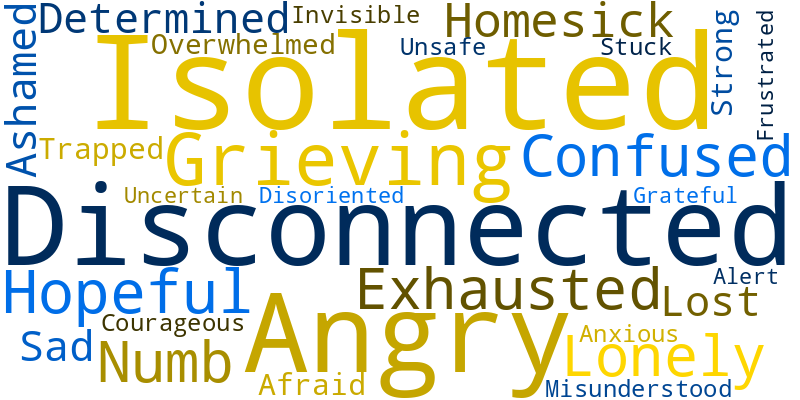
Following best practice, we asked our Ukrainian colleagues at SOFTHOUSE GROUP, who are culturally adapting and coding the course, to review and comment on the words we selected. The request was straightforward: remove words that didn’t resonate, and add or emphasize words that reflected their lived experience.
What happened next was eye-opening. It wasn’t a quick translation or review. We didn’t pull out a thesaurus to offer similar words that might be more impactful. And instead of taking a couple of days, it took several weeks.
The task initiated a lot of discussion and debate amongst the Ukrainian team, and it ended up involving other colleagues, friends, and relatives. What was especially interesting were differing insights from Ukrainians who remained inside their country, versus those who were forced to live abroad.
Several powerful adjustments were made:
- New words were added that felt more authentic, including ув’язнений (imprisoned), безвихідний (hopeless), and важкий (heavy).
- Certain words were emphasized because they resonate so deeply in the Ukrainian context: Принижений (humiliated), Відірваний (torn away), Загублений (lost), Незрозумілий (misunderstood), Невизначений (uncertain), and Розчарований (disappointed). These now dominate the adapted cloud.
- Trapped was replaced. In English we had trapped, but in Ukrainian this term carried strong POW and captivity associations. The team agreed it should be removed and substituted with безвихідний (hopeless), which more accurately reflects lived experiences of displacement.
- Ashamed became Humiliated. The word Присоромлений (ashamed/embarrassed) didn’t fit the context. Принижений (humiliated) was chosen instead, as it conveys a deeper, externally imposed sense of shame.
- Nuances of tone were considered. For example, Приголомшений (overwhelmed) and Приголомшливий (overwhelming) were seen as too similar; only one was kept. Similarly, Тужить за домом (homesick) was modernized to Сум за домом (longing for home).

These changes weren’t just aesthetic – they reshaped both the emphasis and the vocabulary of the program. And the image was important: it appears on the very first course page, and we needed it to convince displaced Ukrainians that we understood how they felt, and convince them that although funding was from Evolution Health, the Larta Institute, and Gilead Sciences, it was adapted by Ukrainians at SOFTHOUSE GROUP, and was truly “By Ukraine, For Ukraine”:
To make the differences clear, here’s a side-by-side visual of the difference:

Reflection
Cultural adaptation isn’t just a matter of translation. It’s about resonance – making sure language reflects the lived experiences of the audience application is meant to serve.
What struck me most in this exercise was how subtle differences altered the emotional tone. Trapped became hopeless. Ashamed became humiliated. These aren’t just minor tweaks, they reshape how participants may experience the program, and whether it feels legitimate.
For digital mental health, this matters enormously. A program can only reach scale if the people using it feel that it reflects their reality. Without that legitimacy, even the most evidence-based intervention will risk being dismissed as irrelevant – or worse – offensive.
Takeaway
Language builds trust. Trust is the foundation for impact. The Shared Strength project reminded me that technology alone can’t create change – people create change.
By listening to our displaced developers even the smallest details, like a single word, can help us create resources that are authentic, effective, and scalable.
I’d love to hear from others working in digital health or refugee care:
- How have you approached cultural adaptation in your own work?
- What lessons have you learned from listening to lived experience?
- How can we scale digital health in a way that meets diverse needs of individuals worldwide?
Notes:
- You can read the original stakeholder article (An Assessment Framework for e-Mental Health Apps in Canada: Results of a Modified Delphi Process), published in JMIR Publications by lead author Jennifer Zelmer, here: https://mhealth.jmir.org/2018/7/e10016/
- My career trajectory owes a lot to the hard working scientists at CAMH , particularly my first advisor Dr. Robert Mann. CAMH continues to do groundbreaking work in mental health and addictions, and the work they do goes well beyond academics and reaches communities and individuals who need help. Please consider donating to CAMH Foundation here: https://www.camh.ca/en/driving-change/about-camh/the-role-of-camh-foundation?form=Donate.
- Follow Sarah Chamberlin‘s series Inside CAMH: https://www.linkedin.com/company/camh-foundation/posts/?feedView=all
- I will be speaking about Shared Strength at EMHIC25, the 10th Digital Mental Health Global Conference hosted by the eMental Health International Collaborative (eMHIC) . eMHIC25 isn’t just a conference. It’s a working forum where the future of mental health will be shaped by those who participate. Learn more.