PeerOnCall

Share this initiative
Key Details

Organisation Name

McMaster University

Location

1400 Main St W, Hamilton, ON L8S 3K2
Canada

Website

Social

eMHIC Member Status

Community Member

At a Glance

Description

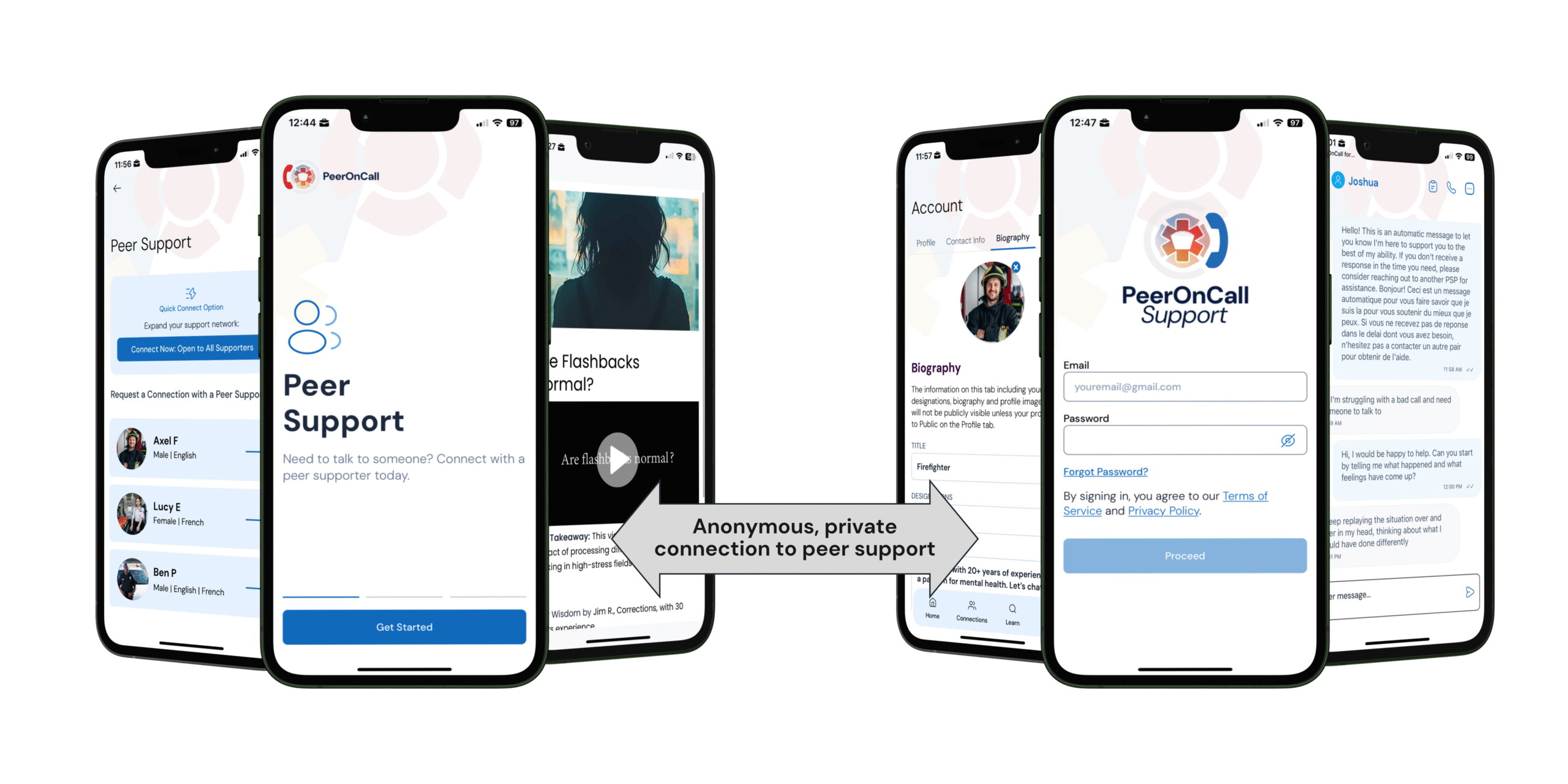
PeerOnCall is a mobile mental health and peer support platform co-designed by and for First Responders that includes: a) an app for frontline workers, b) an app for peer support providers, and c) an administrative portal for organizational leaders.

Implementation Status

Scaling implementation

Launched in May 2023, PeerOnCall has been implemented in 40+ organizations across Canada as part of a research trial, providing access to 12,000+ public safety personnel across fire, paramedic, corrections, police, and communications services.

Target Population

Public Safety Personnel/First Responders

Employees in healthcare organisations, from hospital to community, benefiting from mental health information and peer support

Impact & Outcomes

3-6 month trial in 42 First Responder organisations (2022-2024)
App usage analytics in portal (anonymous, aggregate data)
12% - 49%
% of employees in organization who download the app
152
Connections made to peer supporters from seekers
5,100+ sites
Employees with app access, across the 42 participating organisations
12% - 49%
% of employees in organization who download the app
152
Connections made to peer supporters from seekers
5,100+ sites
Employees with app access, across the 42 participating organisations
This app has so much potential because it takes the awkwardness out of asking for help. You don't have to look someone in the eye and admit you're struggling. You can just type it out. The anonymity, the ability to reach out at any time, it's revolutionary for us.

KU (EMS)

One thing the app has going for it is the ease of access. I mean, you don’t have to remember phone numbers or search through emails to find contact info. It’s all right there.

KU (Police)

A lot of people don't want to admit they're struggling, but at least you know they could download the app, not tell anybody, and kind of watch these short videos that might resonate with them, which I think is a nice tool in the toolbox….

KU (911 Communications)

This app is exciting because it is an opportunity for firefighters- both paid and volunteer, to access peer support in an innovative way that is unique to their needs. You can explore the resources and peer wisdom videos if you are not ready to connect to a peer supporter. This is a much needed resource and tool for both firefighters and peer supporters.

KU (Fire)

Related Articles
Knowledge Bank images-2025 (21)
China Global Dialogue Forum: Digital innovation driving mental health transformation

Interconnected Magazine

Now accepting submissions of interest for the upcoming issue.

Interconnected is the world’s only digital mental health magazine.

Want to be featured?

Email [email protected]

Initiative Overview

The Current Gap

Public Safety Personnel experience disproportionately high rates of psychological illness ad injury, including post‑traumatic and cumulative stress injuries and moral injury. Many face persistent barriers to accessing care, including stigma around help‑seeking and limited access to support providers who understand the unique culture of public safety.

Peer support is widely recognized within PSP communities as a trusted, first line of support, yet many organizations lack the infrastructure, or staffing to maintain accessible peer support programs, particularly across regions, shifts, and rural or remote settings.

PeerOnCall was designed to address this gap: to build a trauma-informed, evidence-based app platform that would make peer support accessible and private, and enable connections to relevant supports at a time and place that works for the user.

PeerOnCall was developed through a multi-year, participatory design process shaped by the public safety community. Early pilot work (2017–2021) explored digital peer support, highlighting the need for stronger privacy, scalability, and anonymous text-based support. Extensive stakeholder engagement, beta testing, and co-design across multiple provinces informed the platform’s core features.

Since 2022, PeerOnCall has evolved into a nationally deployed, research-informed platform of twinned apps supporting both PSP users and trained peer supporters. PSP voices guided development at every stage to ensure trust, usability, and cultural relevance.

PeerOnCall was recently reviewed and approved through the Mental Health Commission of Canada. Research on implementation of PeerOnCall has been published: Here is the link: https://pmc.ncbi.nlm.nih.gov/articles/PMC12386291/

Our Solution

PThe PeerOnCall Support app provides resources for peer supporters to indicate their availability, track connections and respond to those seeking support. PeerOnCall users can browse supporter profiles, connect anonymously and securely by text or phone, access mental health resources, and provide anonymous feedback.

It also supports quality improvement and evaluation through anonymous reporting, and offers resources for peer supporters to support them in their roles. Together, the apps create a confidential, user-controlled digital bridge that improves access to peer support while reducing barriers to help-seeking.

Key Features

1

Outreach to Peer Support

Access private, confidential help (text or phone) from your choice of trained peer support providers. Provide anonymous feedback on your experience.

2

Customized content and resources

Access to 80+ ‘peer wisdom’ videos, local resources, and evidence-informed mental health content customized for public safety personnel.

3

Self-management tools

Self-screening tools, and wellness tracking. Customize your private wellness toolbox with images to keep you grounded.

Collaboration in Action

Main Collaborators

PeerOnCall was developed by researchers at McMaster University, in partnership with the Canadian Institute for Public Safety Research and Treatment (CIPSRT), with early contributions from the RCMP and Defense Research and Development Canada. Leaders, frontline workers and researchers from the public safety community across Canada have been integral to co-design and evaluation. Funding for research and development was provided by the Canadian Institutes for Health Research, the Public Health Agency of Canada and Movember.

Join Our Global Community

Three ways to get involved:

Choose the level that fits.

Key Learnings

Implementation was shaped by high PSP workload and system strain, including staffing shortages, burnout, wildfire response demands, and shift work, which limited recruitment and participation.

Multi-level leadership approval processes created barriers, particularly in larger or provincial/federal organizations.

Technology infrastructure issues—such as firewalls, IT security requirements, inconsistent connectivity, and restricted phone access—interfered with onboarding and app use.

Limited peer support capacity constrained participation in some settings, and concerns about resources and long-term sustainability affected organizational willingness to adopt and maintain the intervention.
Successful implementation requires early attention to workforce capacity, organizational culture, leadership pathways, and technology readiness. Flexible engagement strategies are needed to accommodate PSP workload pressures and shift-based schedules.

Streamlined approval processes and early leadership alignment can reduce delays in uptake.

Technology onboarding must proactively address IT security requirements, connectivity barriers, and device restrictions.

Building or strengthening peer support infrastructure—often through shared or staged models—is a key enabler.
International collaboration is essential to strengthen methodological rigour, co-design approaches, and interpretation of findings.

Public safety systems face similar challenges across countries, including high workload, stigma, and limited peer support infrastructure.

Engaging international partners enables cross-context learning on digital peer support design, privacy considerations, implementation strategies, and sustainability planning.

These perspectives can help to refine the intervention and situate findings within a broader evidence base.

Overall, collaboration enhances the study’s conceptual strength and ensures the platform is informed by diverse public safety and implementation science perspectives.

Looking Ahead

Future work will focus on scaling PeerOnCall across additional public safety settings and exploring sustainable implementation and funding models to support long-term adoption.

Ongoing efforts include refining organizational onboarding processes, strengthening shared peer support infrastructure models, and identifying approaches to sustain technology maintenance and support.

The team is also conducting a CIHR-funded randomized clinical trial within fire services to evaluate the effectiveness, implementation, and impact of PeerOnCall in supporting access to peer support and psychological well-being among firefighters.
We are looking for 20 career or volunteer fire services across Canada to join a research study implementing the PeerOnCall app within their organization for 1-year. Organizations will be randomly assigned to either “standard” or “structured” implementation support. All organizations will receive free access to PeerOnCall and PeerOnCall Support for the duration of the trial.

We are also looking for approximately 20 firefighters (volunteer or career) to participate in building a peer support network and resources for firefighters across Canada. Inquires can be sent to [email protected]
The long-term vision for PeerOnCall is to maintain a high quality, secure platform that optimizes access for the public safety community. Future goals include identifying sustainability and technology partners to support long-term hosting, maintenance, and growth of the platform, while ensuring accessibility for under-resourced public safety organizations that may otherwise lack peer support infrastructure.

We hope to scale implementation within and outside of Canada, including scalable and shared models of peer support that increase access, reduce barriers to help-seeking, and support culturally relevant, confidential support for diverse PSP populations.
female_icon.png

Key Contact

Dr. Sandra Moll
Principal Investigator
McMaster University

Email

Website

female_icon.png

Key Contact

Melissa Parker
Research Coordinator
McMaster University

Email

Website

Media

Introduction to PeerOnCall

Resources

PeerOnCall App Overview

PROMOTION

Directory Banner Placements (9)