The digital mental health landscape has changed considerably in the past two decades. Online psychological treatment has moved from emerging research to established clinical care, supported by growing evidence across conditions and populations.
With that maturity comes new questions about scale, workforce, engagement, equity and the place of digital services within broader systems of care.
MindSpot has been part of that evolution since 2012. As one of Australia’s pioneering national digital mental health services, it has provided free, Australian Government-funded psychological assessment and treatment to more than 300,000 adults. Fourteen years of national delivery have helped establish what it takes to translate research into accessible, effective and sustainable digital psychological care at scale.
Guiding Principles
MindSpot was founded on a commitment to consumers and staff, and a conviction that quality mental health care should be available regardless of where someone lives or what they can afford.
Realising that ambition required safe, clinically effective and cost-efficient models of care, and a skilled team capable of building trust in a relatively new form of psychological treatment.
Collaboration with consumers, service partners, the Australian Government and national and international advisers helped shape MindSpot’s development. So did a commitment to stewardship: a responsibility beyond its own service, to contribute to the wider field through high-quality care, workforce development and national safety and quality standards.
Research and service, side by side
MindSpot was founded on a strong collaboration between research and service delivery. MindSpot developed out of research into internet-delivered cognitive behavioural therapy (iCBT) initially at the Virtual Clinic at St Vincent’s Hospital and UNSW and then at Macquarie University’s eCentreClinic. Led by Professors Nick Titov and Blake Dear, this early work grew through collaborations with researchers in Australia and internationally.
Early studies asked whether online psychological treatment could be safe and effective, and how different levels of support affected outcomes and resources required. A 2010 randomised controlled trial found substantial improvements in depression symptoms among participants receiving either clinician-assisted or technician-assisted online treatment. Both approaches required approximately 60 minutes of support per participant over eight weeks. The findings offered early evidence that effective psychological treatment could be delivered online with relatively modest staff time.
MindSpot brought this research into national clinical practice, making psychological assessment and treatment available to adults across Australia without a referral or cost. Its specially trained mental health professionals support a range of structured online courses addressing anxiety, depression, obsessive-compulsive disorder, post-traumatic stress disorder, insomnia, chronic pain and distress associated with chronic health conditions. The service also provides brief telephone-based psychological treatment. The ultra-low-intensity Big 5 wellbeing program uses daily SMS reminders, self-assessment tools and practical resources to help people build habits associated with better mental health.

The research program has continued alongside the service. Together, MindSpot and the eCentreClinic have conducted more than 100 clinical trials involving over 10,000 participants and published more than 200 peer-reviewed papers. New approaches are evaluated through research, while routine clinical data shows how treatments perform in the real world and where the gaps and opportunities lie. That proximity between research and care remains one of MindSpot’s defining features.
Understanding why people seek help
MindSpot’s free online assessment is the first point of contact with the service, but not necessarily the first step towards treatment.
In the service’s first seven years, more than 121,000 people started an assessment. More than a third had never previously spoken to a health professional about their symptoms. By 2019, around two-thirds said assessment and information were their main reason for using the service.
These findings showed that assessment does more than open a door, and the people walking through it are not all heading to the same place. For some, understanding what they are experiencing is the help they came for. Through personalised feedback, the option to speak with a clinician and pathways to treatment where appropriate, MindSpot’s assessment can serve as a brief clinical intervention in its own right, without making treatment the only meaningful next step.
Outcomes at scale
More than a decade of national delivery has given MindSpot a substantial body of clinical evidence on treatment outcomes.
Among adults who have received iCBT through MindSpot, symptoms of anxiety and depression have reduced by 40 to 50 per cent on average, with improvements sustained beyond treatment. Research has also found comparable outcomes among men and women, people with different levels of symptom severity, First Nations peoples, people taking antidepressants, people from different socioeconomic backgrounds and those managing chronic health conditions.
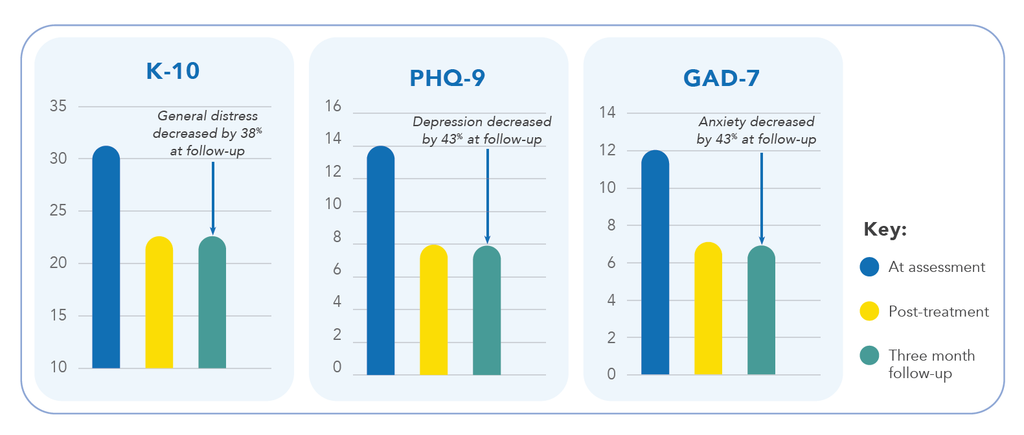
These outcomes also speak to MindSpot’s founding commitment to equitable care. In 2024, 40 per cent of MindSpot users lived outside metropolitan areas. Research examining regional and remote patients receiving therapist-guided online treatment found outcomes comparable to those in major cities, with improvements maintained at three-month follow-up. Together, these findings highlight the importance of extending access to psychological treatment while ensuring people receive effective care, wherever they live.
Beyond Australia, MindSpot’s research has contributed to the development of digital psychological care internationally. Its Wellbeing Course is now used by digital mental health clinics in Canada, and the MindSpot model has informed similar clinics in several countries.
Listening and learning
Clinical outcomes are essential to understanding treatment effectiveness, but they cannot tell the whole story of how people experience care. Consumer perspectives offer another source of insight, helping identify barriers and opportunities to make services more accessible, relevant and responsive.
In 2022, MindSpot established its Consumer Engagement Network and engagement framework. By 2025, more than 1,200 people had joined the network, representing every Australian state and territory, with 37 per cent living outside capital cities. The network’s input has informed improvements to treatments, service pathways, programs and communications.
Teletherapy provides one example of this approach in practice. Following feedback from consumers and staff, MindSpot trialled brief telephone-based treatment in January 2022. Within five months, it was an established part of the service’s treatment options.
The people behind the service
MindSpot’s story is as much about the people who built it as the research and technology that made it possible.
Over the years, MindSpot has attracted and nurtured highly skilled people across clinical care, research, software engineering, service development and support. The expertise and dedication of the MindSpot team, united by a commitment to providing high-quality psychological care, have been central to building and sustaining the service.
Equally important has been the culture that brings them together. MindSpot’s investment in its people has been recognised through numerous workplace culture awards, including being named one of Australia’s Best Workplaces™ in Healthcare & Social Assistance by Great Place To Work® for two consecutive years.
That commitment extends to the next generation. Established in 2019, the MindSpot Academy was founded to address a need for specialised, high-quality training in digital mental health care.
Today, the Academy provides structured training and supervision to clinicians across Australia, supporting the development of skills, confidence, and excellence in digital mental health practice. Through its Australian Government-funded Clinical Pathways Program, the Academy will also supervise 80 psychology interns nationwide, helping to strengthen the future mental health workforce and expand access to quality care for Australians.
The next chapter
Fourteen years on, MindSpot is beginning a new chapter under the leadership of Katherine Burchfield, as the Executive Director of MindSpot and Mental Health Services, taking over from founder Distinguished Professor Nick Titov AM. Katherine brings over 25 years of experience and leadership across health service delivery, digital and integrated care, policy and system reform in Australia and internationally, and a strong passion for mental health, innovation and equitable access.
MindSpot’s vision – to build an emotionally resilient world – is as relevant today as when we began. This next chapter is about thinking boldly about what that purpose can mean, and how we can increase our impact.
MindSpot believes everyone should be able to access effective, evidence-based psychological care that supports them to take an active role in their own recovery and wellbeing. Digital care has a critical role to play in making this possible. The opportunity ahead is to extend the reach and impact of what works in digital mental health. That means reaching more people who face barriers to traditional care, and those for whom digital models offer better outcomes. It means continuing to build the evidence base with our research partners. And it means helping to develop the workforce and skills the system needs to deliver high-quality care in new ways. We will work more deliberately with partners across the health system to make care more connected, responsive and comprehensive.
The ambition is not simply to grow MindSpot. It is to help shape the future of accessible, effective mental health care – challenging ourselves and the system to think differently, and working with others to get there.
Throughout, we will keep asking the questions that matter: who are we reaching, who are we missing, and how can we do better?