The need to serve those who served
Across many nations, the service and sacrifices of military members and their families contribute to domestic security, prosperity, and international order. Yet, that service can come at a steep cost for those who dedicate themselves to this work. Military service is inherently a high-risk occupation for physical and psychological injury, not only through overseas deployments and combat, but also through domestic operations, trainings, and other realities of military life. Accordingly, military members can be frequently exposed to significant stressors and potentially traumatic events (Phelps et al., 2022).
This takes a toll. While prevalence figures vary internationally, elevated rates of PTSD, anxiety, depression, and substance use disorders among Veterans are well documented, including across the Five Eyes countries (Australia, Canada, New Zealand, the United Kingdom, and the United States), and these rates are commonly higher when compared to community samples (Phoenix Australia and the Atlas Institute for Veterans and Families, 2020).
The cost of service isn’t just limited to the serving member, either. Families of military members and veterans face unique stressors, and can experience distinct effects on their own mental health and well-being, including operational stress injuries, PTSD, depression, and anxiety. Caregiver burden and burnout also add to the stressors faced by military and veteran family members, underscoring the need for support systems to integrate family-centered care (Mulligan et al., 2026).
As a result of these realities, countries like the Five Eyes nations and others face significant social and economic consequences. While that alone necessitates action, there’s also a sense of obligation for nations to serve those who have selflessly served for the greater good (Phelps et al., 2022).
The status quo isn’t cutting it
Given the evidence, there is a pressing need to improve the mental health and wellbeing outcomes for veterans and their families. There is wide recognition that current systems aren’t optimized to achieve the ideal outcomes. The primary barrier to improving outcomes, though, isn’t a lack of effective interventions. Rather, it’s often a lack of mobilizing and effectively implementing best practice interventions. Further, while pockets of high quality, evidence-based services exist, across the international landscape, veterans and families still face seemingly incoherent systems that lack coordination, can be inaccessible and complex to navigate, and aren’t appropriately matched to their needs (Phelps et al, 2022). This is a systemic barrier that requires systemic solutions fit for today and the future. This can be achieved through co-designing and implementing a stepped matched model of care, with digital integration throughout.
A vision for change: Inclusive, integrated, principles-based system redesign
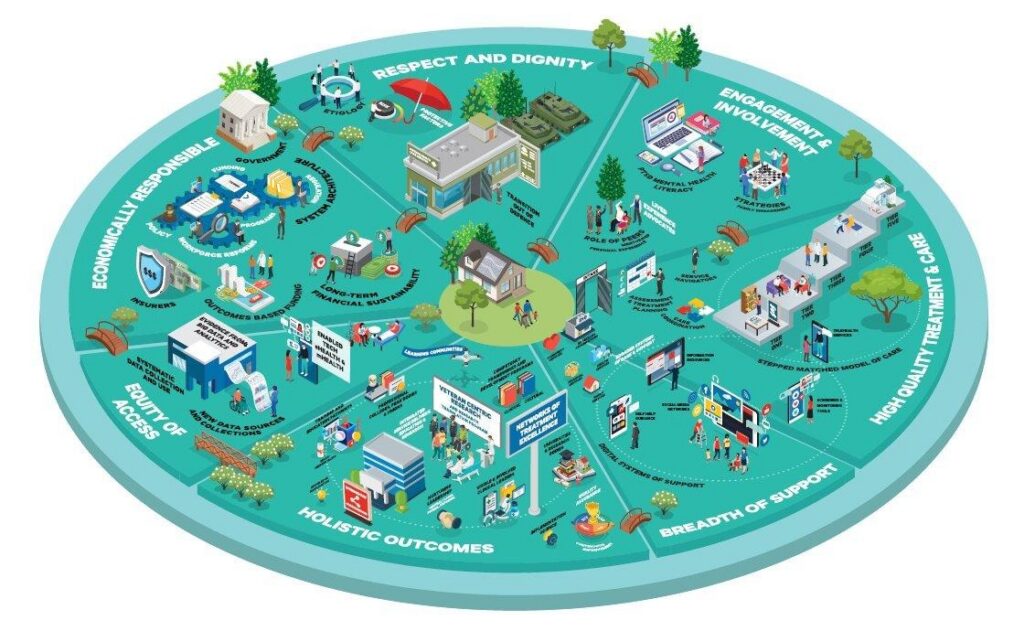
Recognizing the challenges various countries are facing to effectively improve mental health and wellbeing outcomes for veterans and families, the Atlas Institute for Veterans and Families partnered with Phoenix Australia Centre for Posttraumatic Mental Health to develop a blueprint for future system design. Grounded in the 7 principles of: 1) respect and dignity, 2) engagement and involvement, 3) equity of access, 4) breadth of support, 5) high quality treatment and care, 6) holistic outcomes, and 7) economic responsibility, this conceptual framework is intended to offer an adaptable, overarching system model and ‘scaffold’ to build an effective system of services and supports that better meet the needs of veterans and their families. The framework offers a structure to map current and planned initiatives, and understand where services are in relation to current evidence-based practices and emerging practices. Recognizing the diversity among veterans, families, and the systems that serve them, the framework is not a ‘one size fits all’ approach. Rather, it offers a general guide which service systems can tailor to their population needs and contexts (Phoenix Australia and the Atlas Institute for Veterans and Families, 2020). To facilitate reform efforts, a companion implementation guide was developed, informed by key building blocks of knowledge mobilization and implementation science.
Moving beyond traditional models through a digitally enabled, stepped/matched model of care
These days stepped care models aren’t novel. However, traditional stepped care models typically require individuals to proceed through lower intensity interventions before gaining access to specialized treatment. In some ways, this has forced individuals to ‘fail’ at treatment, rather than starting off with the intervention(s) most likely to achieve the intended results. Accordingly, this proposed framework presents a stepped/matched model of care, which includes services and supports, comprising best and emerging (next) practice interventions, in tiers of increasing intensity and specificity, which individuals and families can access at the level matched best for their need, preference, complexity, risk, and context Throughout the model, there is flexible entry for veterans and families, including the ability to move between levels as needs change; care coordination; and the potential for personalised care (Phelps et al, 2022).
In addition to the entry based on need and fluid movement through the system tailored to an individual’s needs, family-centered integration is critical for any effective system of care for veterans. Recognizing that spouses, children, caregivers and chosen family face distinct operational stress impacts and burnout, family care must be integrated alongside veteran supports rather than treated as a secondary consideration.
Digital as an embedded, rather than extra, element
Given the increased interest in e-mental health services (Canada Health Infoway, 2023), it’s imperative to consider validated e-mental health options as an essential to the suite of services and supports across intervention tiers, as appropriate. As part of the stepped/matched model of care, digital technology and interventions are an essential component. Digital tools can facilitate improved system navigation, through streamlining initial assessments and quickly connecting veterans and families to the right level of care, reducing bottlenecks. Validated e-mental health interventions, particularly at the lower tiers, can be offered to those who are interested and have access, providing immediate, low barrier support, preventing conditions from worsening. While not a panacea for those living in rural and remote areas, we also can’t ignore the potential and demonstrated benefits of tele-mental health and other e-mental health interventions to bridge barriers to veterans and families living in rural and remote areas, and as a support to the providers working in those contexts, as well. Blended models are also another feature incorporated through a stepped/matched model of care, which can both address access barriers and enhance care. Digital platforms can enable clinicians to combine asynchronous tools with in-person or live virtual therapy, allowing continuous engagement and seamlessly facilitating measurement-based care to track progress and support treatment tailoring throughout the treatment and recovery journey.
Growing evidence, but more research needed
Recognizing the distinctiveness of the veteran and family population, there is also a need to ensure accessibility and acceptability among this community. Recent research in Canada has demonstrated increasing support. For example, a longitudinal survey examining the psychological functioning of Canadian veterans during the COVID-19 found that many of the surveyed Canadian veterans found telehealth to be effective and reported having their needs met. Veterans highlighted convenience, accessibility, comfort and safety as advantages (Walker et al, 2024). Still, barriers were also noted, such as accessibility challenges related to disability status, and technological difficulties were also noted, particularly in rural and remote areas (Walker et al, 2024). Tailored digital interventions for veterans, military members and public safety personnel have also expanded in recent years. While promising, there remains a need for more efficacy and effectiveness studies to ensure interventions are meeting the needs of these populations (Allen et al, 2025). A scoping review examining the delivery of virtual therapies among these populations highlights promising evidence and a number of benefits. Yet, it also flags the need for more research regarding the impact of demographic and contextual factors, along with further research related to the client’s stage of treatment, level of functioning, illness severity, attachment style, and comorbidities (Jones et al, 2020). Further research to address the digital divide among trauma-affected military members, veterans, and/or public safety personnel was also highlighted (Jones et al, 2020).
The path forward
While the Atlas Institute and Phoenix Australia’s proposed framework is conceptual, its ability to serve as a roadmap can be practically applied by various systems. Recognizing the complexities across many mental health systems, the practical building blocks in the corresponding implementation guide can support concrete next steps. Central to this work is the need to collaborate across a wide range of interest holders, such as policymakers, service delivery organizations, insurers, regulators, intermediary organizations, researchers, and importantly, veterans and families themselves. Co-design is a critical facilitator to bring system change to life, as well as to guide the ongoing research required to establish and continually evaluate best and next practice interventions, whether in person or digital. With the support of the framework and guided by its principles, reforming mental health systems to improve outcomes for veterans and families is one that can be accomplished with collective effort. By continuing investments in digital infrastructure, tools, and programs; standardizing measurement-based care; co-designing pathways to care; and co-evaluating system changes over time, countries around the world can build a responsive mental health system to better serve veterans and families.