ReachOut PeerChat

Share this initiative
Key Details

Organisation Name

ReachOut Australia

Location

National service (Gadigal Country, Suite 11.02, 323 Castlereagh Street, Sydney NSW 2000)

Social

eMHIC Member Status

Strategic Partner

At a Glance

Description

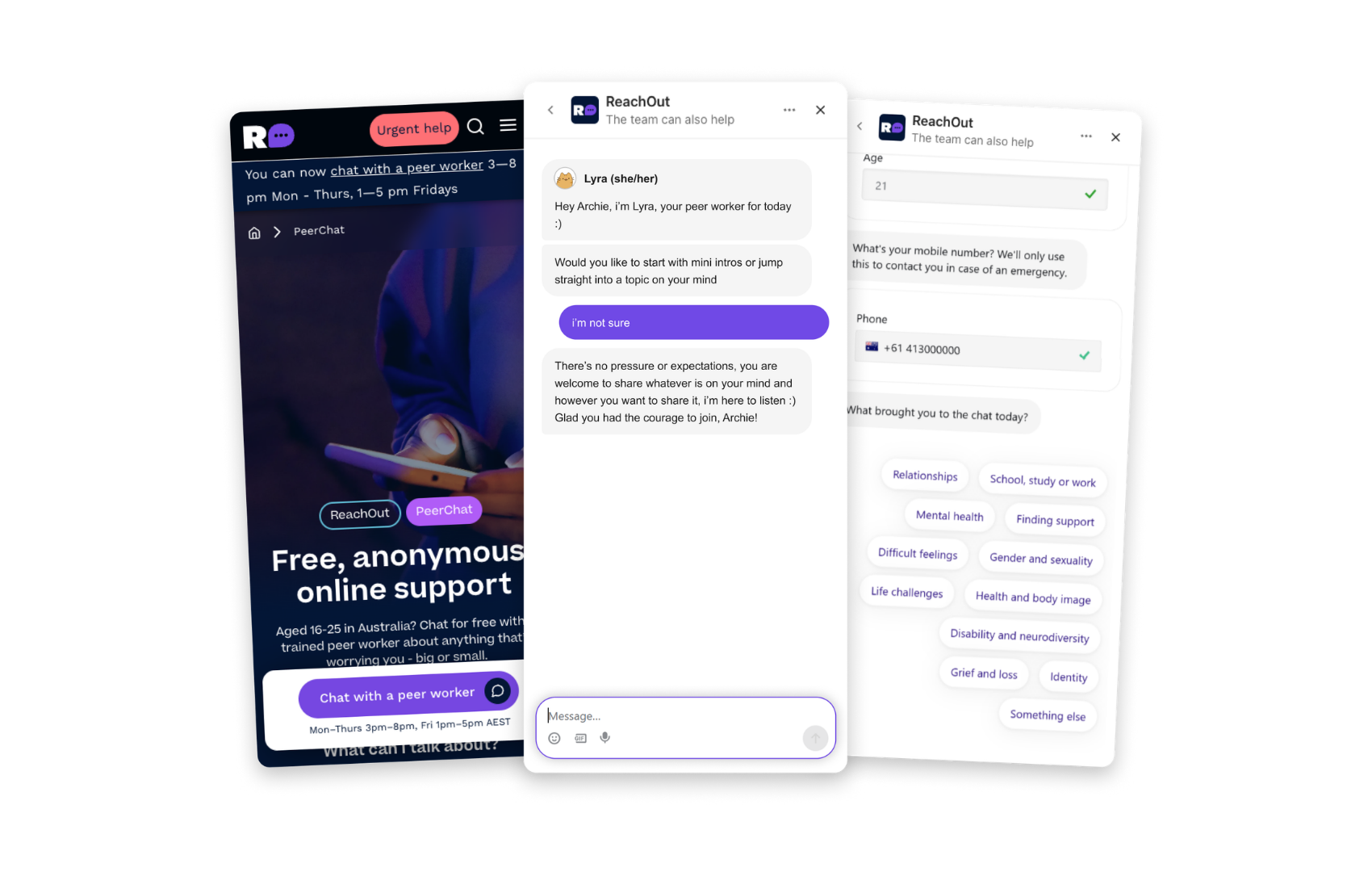
ReachOut PeerChat provides real-time chat-based support for young people aged 16–25. The free service connects young people with trained peer workers who have their own lived experience of mental health challenges. Young people can chat anonymously under a pseudonym.

Implementation Status

Scaling implementation

PeerChat is a one-to-one text-based platform available online. It is an on-demand service available Mon–Thurs 3pm–8pm, Fri 11:30am–4:30pm AET. It is continuously improved to ensure relevance and efficacy.

Target Population

Young people

Young people in Australia aged 16-25.

Impact & Outcomes

2024–25 Australian financial year.
86%
Believe PeerChat is a safe and supportive space.
87%
PeerChat users felt better after their session.
4,557
PeerChat sessions in 2024–25.
81%
PeerChat users feel it is safe.
91%
PeerChat users would recommend it to others.
78%
PeerChat users felt less alone in their experience
86%
Believe PeerChat is a safe and supportive space.
87%
PeerChat users felt better after their session.
4,557
PeerChat sessions in 2024–25.
81%
PeerChat users feel it is safe.
91%
PeerChat users would recommend it to others.
78%
PeerChat users felt less alone in their experience
‘Being able to talk to people my age who understand things I am going through ... has been a godsend. I honestly wouldn’t be where I am today without it.’

Young person aged 16–25 years

‘It was helpful to have someone that I could talk to, [to] help articulate and validate my experiences, and who I felt [was] genuine.’

Young person aged 16–25 years

‘I incorporated some of the relaxation tips that the peer support [recommended].’

Young person aged 16–25 years

‘PeerChat is powerful because we’re meeting young people where they’re at, behind a screen where they feel safe and anonymous. We’re a low-barrier entry point into mental health support that is validating and non-judgemental. Our lived experience says, “We’ve navigated this too, we believe you, and your feelings are valid.”’

ReachOut’s Peer Workers

‘It calmed me down and I didn’t feel alone at that moment. I could really connect.’

Young person aged 16–25 years

‘It made me feel less lonely talking to someone, even though it was just chatting. It was good to get stuff off my chest to someone I don’t know personally …’

Young person aged 16–25 years

Related Articles
Knowledge Bank images-2025 (21)
China Global Dialogue Forum: Digital innovation driving mental health transformation

Interconnected Magazine

Now accepting submissions of interest for the upcoming issue.

Interconnected is the world’s only digital mental health magazine.

Want to be featured?

Email [email protected]

Initiative Overview

The Current Gap

Research shows that traditional clinical interventions can be confronting, a poor fit and inappropriate for some young people. Young people want one-to-one peer-led, collaborative support available at short notice in an environment where they feel comfortable and safe. This highlights a critical gap between traditional models of care and how young people seek help today. As the mental health system shifts to being increasingly recovery-oriented and person-centred, services that respond to the unique needs of each person, and enable young people to be heard, hear from others with lived experience and feel supported to make their own choices, in a stigma-free and safe way, are critical.
ReachOut PeerChat is underpinned by the ReachOut Model of Care, the PeerChat Duty of Care Framework, the National Framework for Recovery-Oriented Mental Health Services and the Trauma-Informed Care Model. In 2025, we conducted our first evaluation of the service since its launch. The evaluation found that PeerChat is having a positive impact and is encouraging people to take action.

Our Solution

Launched in 2022, ReachOut PeerChat was the first-of-its-kind digital peer support service. PeerChat provides real-time chat-based support for young people aged 16–25. Building on over a decade of experience in digitally-delivered peer support, it is designed to support young people facing mental health difficulties and everyday challenges. The service connects young people to peer workers through a text-based platform, where they can chat anonymously using a pseudonym. Free and confidential, PeerChat addresses the unique barriers that prevent many young people from seeking help. The service is non-clinical, peer-led, recovery-oriented, solution-focused, anonymous and available for in-the-moment support.

Key Features

1

Co-designed with young people and peer workers

Co-design ensures the service is safe and relevant for users and our lived experience workforce.

2

On-demand text-based service

PeerChat is available online and on demand, enabling in-the-moment support.

3

Anonymous

PeerChat is an anonymous and secure space. Young people can seek support without fear of judgment.

4

Lived experience and peer-led

Shared lived experience and peer-led support build authentic connections and transform personal challenges into a powerful tool for recovery.

Collaboration in Action

Main Collaborators

None listed. Please contact Elaine Fowler (details below) for collaboration enquiries.

Join Our Global Community

Three ways to get involved:

Choose the level that fits.

Key Learnings

A key challenge was ensuring that ReachOut’s lived experience workforce was integrated into the broader organisation. It can be common for peer workers and frontline teams to feel siloed. We addressed this by prioritising lived experience leadership and embedding the values of lived experience in our organisation’s strategy. Fostering this integration remains a key priority, which we achieve through collaboration/consultation with the peer workers, clear structures and policies, and ongoing organisational learning.
Co-produce/co-design your services with your users and frontline workers. Implement risk mitigations for a lived experience workforce to reduce the likelihood of vicarious trauma and burnout. This can include regular team meetings, support personnel in place, scheduled supervision, opportunities for professional development and lived experience leadership. Roster in time for professional development and supervision, project work, and cross-collaboration opportunities.
N.A.

Looking Ahead

Next steps include: supporting our peer worker workforce in their professional development by facilitating training from a newly appointed clinician in the service optimising workforce planning and rostering progressing our warm referral partnership with Orygen’s MOST service Promoting the service and sharing our learnings on safely scaling a lived experience workforce to encourage sector-wide continuous improvement.
In the future, we will continue scaling our support service to enable greater reach to help-seekers. This might include: Expanding our operating hours to include weekends Cross-sector collaboration We will also continue to promote our services and share our learnings at conferences and workshops to build trust and establish ourselves more widely as educators on building safe and scalable lived experience workforces.
female_icon.png

Key Contact

Elaine Fowler
Senior Manager - Service Deliver
ReachOut Australia

Media

What is ReachOut PeerChat?
ReachOut PeerChat