MIRA the Mental Health Virtual Assistant

Share this initiative
Key Details

Organisation Name

Mood Disorders Society of Canada

Location

Hope Crescent, Belleville Ontario, Canada
Canada

Website

Social

eMHIC Member Status

Community Member

At a Glance

Description

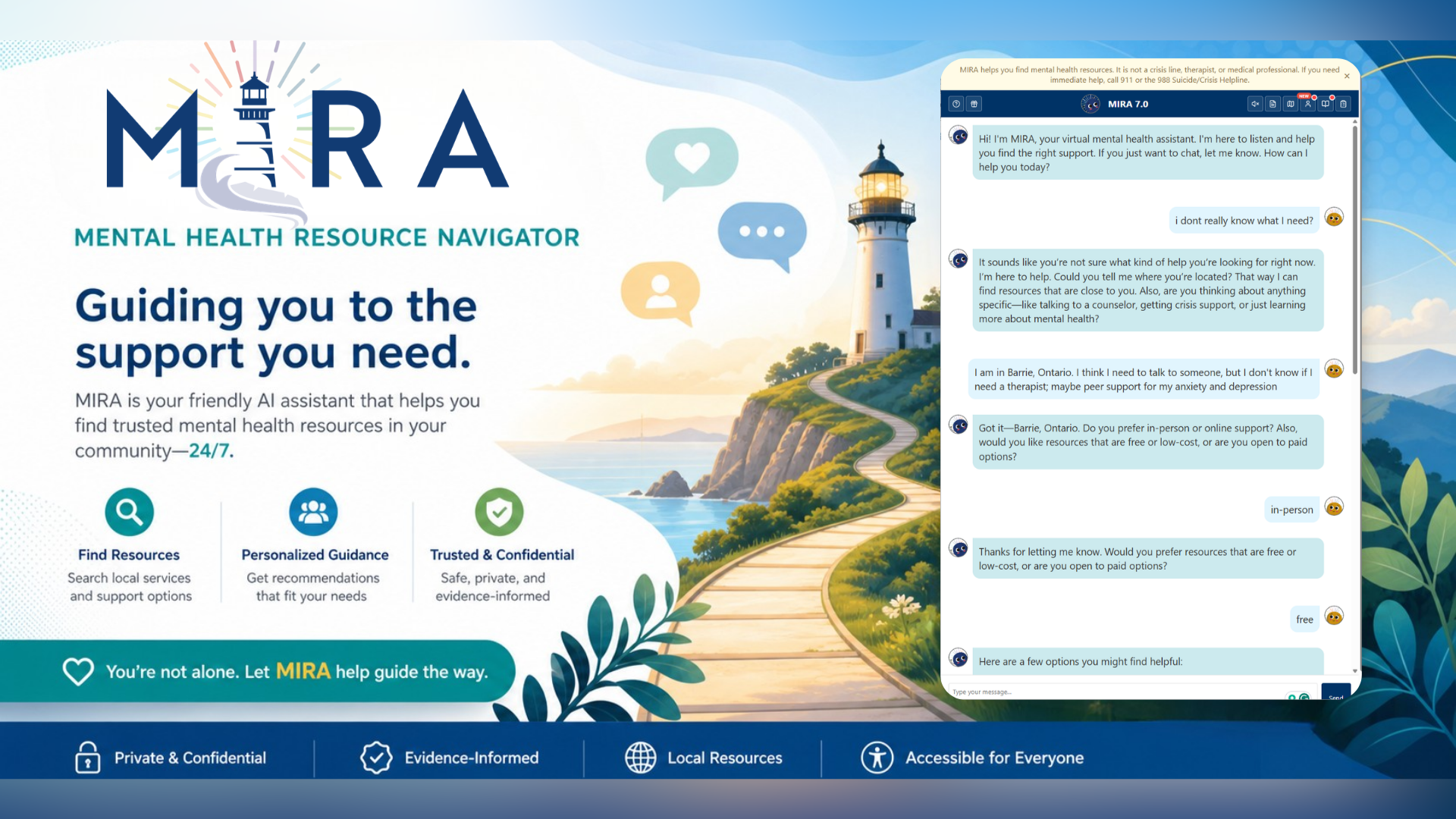
MIRA is a free, anonymous AI mental health navigator that helps people find trusted, vetted supports and services in Canada. It’s built to guide users to the right resource at the right time, without relying on the open internet.

Implementation Status

Scaling implementation

MIRA 7.0 is live featuring enhanced explainability, accessibility, and safety features; ongoing work focuses on offline capability, voice access, and evaluations with partners to scale equitable mental health navigation.

Target Population

All Canadians

Available for all Canadians looking for mental health resources

Impact & Outcomes

Aug 2025 to July 2026
We’ll measure outcomes through usage analytics, user surveys, and focus groups, then track version releases, reach, accessibility gains, publication output, and trainee support over time.
65000
delivered trusted resources to users
83%
positive approval rating from users.
48
Unique conversations a day
2820
Volunteer hours
7
Versions deployed
1
Mobile app prototype launched
5
highly qualified trainees supported
65000
delivered trusted resources to users
83%
positive approval rating from users.
48
Unique conversations a day
2820
Volunteer hours
7
Versions deployed
1
Mobile app prototype launched
5
highly qualified trainees supported

Interconnected Magazine

Now accepting submissions of interest for the upcoming issue.

Interconnected is the world’s only digital mental health magazine.

Want to be featured?

Email [email protected]

Initiative Overview

The Current Gap

MIRA tackles the fact that Canadians facing mental health struggles often can’t find timely, trustworthy help in an overwhelmed, fragmented system. One in three Canadians will face a mental health or substance use issue, yet 44% report unmet needs and wait times often exceed three months. The internet compounds this with widespread misinformation, leaving people unsure where to turn.

MIRA closes that gap by anonymously connecting users to a vetted, expert-reviewed resource library, cutting through confusion, reducing stigma, and directing people to the right support faster, especially those in underserved or equity-deserving communities.

A few things worth knowing: MIRA never pulls from the open internet — every resource is expert-reviewed for accuracy and safety, which sets it apart from typical AI chatbots. It’s built with strong LLM guardrails, including safety classifiers to catch harmful content, and it’s fully anonymous, collecting no identifiable data. MIRA is Canadian-led, university-hosted, and co-designed with people with lived experience and Indigenous communities under OCAP principles. It’s actively evolving — adding explainability features, crisis-service integration, and academic validation through user studies — making it a trustworthy, continuously improving resource for mental health navigation.

Our Solution

MIRA is a proven, growing success — a free, anonymous AI chatbot connecting Canadians to trusted mental health resources instead of unreliable internet searches. Since its pilot with healthcare workers in Alberta and Nova Scotia, it’s expanded nationally, backed by strong academic and community partnerships including the University of Alberta, Dalhousie, and Western University. With over 2,820 volunteer hours invested and continuous version upgrades, MIRA keeps improving through real user feedback and rigorous evaluation.

It’s a genuine, ethical, homegrown Canadian innovation making mental health navigation simpler and more equitable.

Key Features

1

Vetted resource library, no open internet.

Vetted resource library only. MIRA never searches the open internet — every resource is reviewed by an Expert Advisory Committee of clinicians, researchers, and PWLE

2

Built-in AI safety guardrails and classifiers

Built-in AI safety guardrails. A message safety classifier trained on datasets and detects harmful language and jailbreak attempts, keeping conversations safe

3

Fully anonymous, free, and stigma-reducing.

Fully anonymous and free. MIRA collects no identifiable user data, removing financial and privacy barriers and reducing stigma around seeking help.

4

Modular architecture supports flexible partner deployments.

Modular, partner-ready architecture. The backend supports custom prompts, tools, and resource databases for different partners without needing separate deployments, making it adaptable

5

Explainability panel builds user trust transparently.

Explainability panel. MIRA shows users why it asks certain questions and why specific resources are recommended, building transparency and trust in its AI-driven suggestions.


Collaboration in Action

Main Collaborators

  • ab_uni_logo.jpg
  • 2022_MDSCLogo_BL_Side_SM.png
  • sk_uni_logo.jpg
  • dal_uni_logo.jpg
Western University
Alberta Machine Intelligence Institute
APEC Digital Hub for Mental Health
Research Canada
International Indigenous Health Research and Training Centre
Knowledge Institute
Connex Ontario

Join Our Global Community

Three ways to get involved:

Choose the level that fits.

Key Learnings

Balancing empathetic conversation with safety risk was an ongoing tension, per ORCHA evaluation feedback. Meeting accessibility compliance thresholds, like grade-five reading levels, required careful prompt redesign. Funding sustainability also remains a pressing concern. Tagging resources accurately for Indigenous and culturally diverse groups proved difficult, needing expert human review alongside AI.

Provider reliability caused timeouts and incomplete responses, prompting infrastructure improvements.
Build in expert human review from day one — AI tagging and resource curation need clinician and lived-experience input, especially for culturally diverse and Indigenous communities. Prioritize safety guardrails and explainability early; users trust AI more when they understand why it’s asking questions or recommending resources. Don’t underestimate language and accessibility work — French performance and reading-level compliance took real effort to get right. Plan for sustainability from the start, since grant funding timelines rarely match the pace of meaningful development.

Finally, keep the tool anonymous and free; it genuinely reduces stigma and barriers to help-seeking.

International partnerships brought expertise MIRA couldn’t build alone. The APEC Digital Hub for Mental Health and AI4Society contributed global perspectives on AI ethics and mental health innovation, while the International Indigenous Health Research and Training Centre helped ensure culturally grounded, respectful engagement beyond Canadian borders.

These collaborations strengthened MIRA’s credibility, broadened its evidence base, and positioned it within a wider movement toward ethical, explainable AI in mental health — helping MIRA learn from and contribute to international best practices rather than developing in isolation.

Looking Ahead

MIRA’s roadmap focuses on making support more accessible and personal. A free, downloadable and offline-capable mobile app is in development, alongside speech-to-text and text-to-speech features to remove barriers for users with visual or hearing impairments. The team is also exploring emotion detection to help MIRA respond with greater empathy, expanding its explainability panel so users understand exactly why questions are asked or resources recommended, and building an avatar interface for more natural, supportive interactions.

Longer-term, MIRA aims to integrate crisis service connections and pursue rigorous user studies to validate its real-world mental health impact.

MIRA is actively seeking new partnerships to expand its reach and impact. Opportunities include co-developing specialized versions for specific populations (youth, Veterans, Public Safety Personnel), data-sharing agreements to grow the resource library, funding partnerships to sustain development beyond March 2027, and research collaborations on explainability, AI safety, or comparative studies. Organizations interested in deploying MIRA’s widget, contributing resources, or exploring joint research are welcome to reach out.

For collaboration inquiries, contact Ken Porter, National Projects Director, Mood Disorders Society of Canada, at [email protected].
MIRA’s path forward is about deepening trust and reach. Next steps include launching a free mobile app, adding speech-to-text and text-to-speech for accessibility, and exploring emotion detection and avatars for more natural, empathetic interactions. The team is expanding the explainability panel to help users understand MIRA’s reasoning, while pursuing rigorous user studies and comparative research to validate its real-world impact.

Longer term, MIRA aspires to integrate live crisis service connections, evolve into specialized versions for distinct populations, and scale nationally as a sustainable, trusted cornerstone of Canada’s mental health navigation system.
Ken-Porter-Professional-Headshot-v2.png

Key Contact

Ken Porter
National Project Director
Dave Gallson

Email

Website

Resources

Introduction to MIRA
Mental Health Resource Retrieval using Semantic Similarity and Knowledge Graphs
Implementing Digital Navigational Tools in the Mental Healthcare System
Integrating Conversational Pathways with a Chatbot Builder Platform
Developing, Implementing, and Evaluating an Artificial Intelligence–Guided Mental Health Resource Navigation Chatbot

PROMOTION

Directory Banner Placements (9)