Governing Digital Mental Health

Share this initiative
Key Details

Organisation Name

Digital Mental Health Consortium

Location

Sóller, Mallorca

Social

eMHIC Member Status

Community Member

At a Glance

Description

Implementation Status

Pilot initiative

Outcomes will be assessed through qualitative feedback, readiness conversations, stakeholder reflections, training engagement, implementation learning, and evidence of improved clarity around human oversight, responsible AI integration, and workforce adaptation in behavioral health settings.

Target Population

General population

Interconnected Magazine

Now accepting submissions of interest for the upcoming issue.

Interconnected is the world’s only digital mental health magazine.

Want to be featured?

Email [email protected]

Initiative Overview

The Current Gap

Behavioral health systems are entering a period of rapid AI adoption without equivalent development in governance, workforce readiness, implementation guidance, or human oversight capacity. Many organizations lack practical frameworks for integrating AI responsibly into sensitive care environments while maintaining ethical accountability, clinical judgment, and human-centered decision-making.
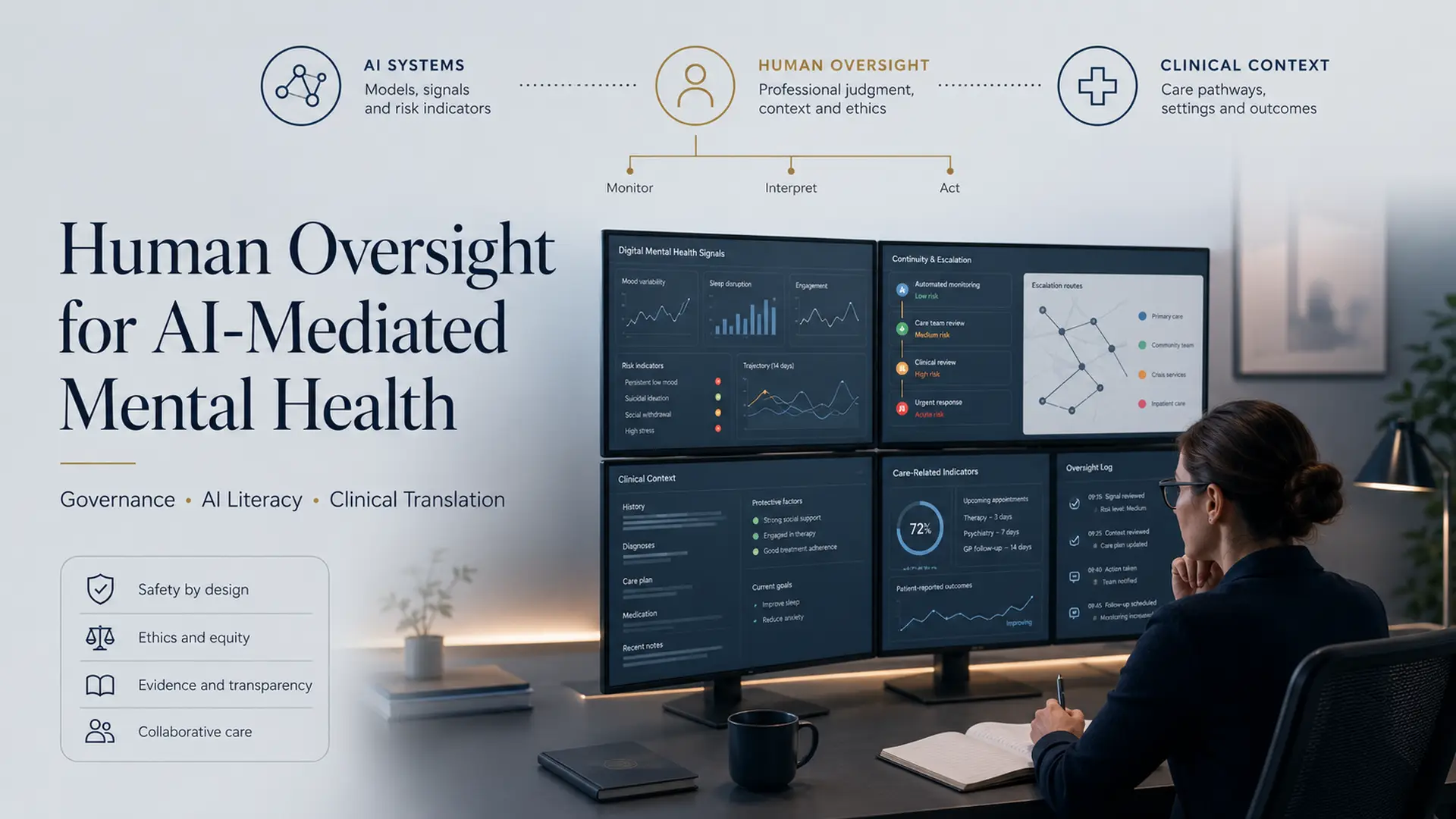
The initiative explores the emerging role of the Digital Behavioral Health Expert (DBHE), a proposed professional framework designed to bridge AI systems, behavioral health practice, implementation strategy, and organizational governance. The work emphasizes interdisciplinary collaboration, systems thinking, and practical adaptation for real-world care environments undergoing digital transformation.

Our Solution

This initiative develops governance and workforce capacity models for responsible AI integration in behavioral health systems. The work includes implementation frameworks, simulation-based learning environments, professional upskilling approaches, and human oversight methodologies designed to support safe, ethical, and operationally sustainable use of AI within digital mental health ecosystems.

Key Features

1

Human Oversight

Human-centered AI supervision frameworks

2

Workforce Readiness

Professional adaptation for AI-integrated care

3

AI Governance

Responsible implementation methodologies

Collaboration in Action

Main Collaborators

Independent collaborators across behavioral health, digital health innovation, AI governance, implementation strategy, and professional education networks.

Join Our Global Community

Three ways to get involved:

Choose the level that fits.

Key Learnings

One of the primary challenges is the rapid pace of AI adoption compared to the slower development of governance structures, workforce preparedness, and implementation guidance in behavioral health systems. Another challenge is helping organizations integrate AI responsibly while preserving human judgment, trust, ethical accountability, and care quality within sensitive environments.
Responsible AI integration in behavioral health requires more than technology adoption alone. Organizations benefit from interdisciplinary collaboration, implementation readiness, workforce adaptation, and clear human oversight structures. Early conversations around governance and professional roles are essential to reduce fragmentation and improve long-term sustainability.
International collaboration is essential because AI-enabled behavioral health challenges are global, interdisciplinary, and rapidly evolving. Shared learning across sectors, countries, and professional communities can help accelerate responsible implementation, reduce duplication, and support the development of common governance and workforce readiness approaches.

Looking Ahead

Future plans include expanding the DBHE framework, developing simulation-based training environments, supporting implementation partnerships, contributing to AI governance discussions in behavioral health, and creating practical educational resources that help organizations integrate AI responsibly and sustainably into care systems.
The initiative is open to collaboration with behavioral health organizations, digital health innovators, educational institutions, implementation leaders, governance researchers, and interdisciplinary networks interested in responsible AI integration, workforce transformation, simulation-based learning, and human-centered oversight models.
The long-term vision is to help build a more human-centered, ethically grounded, and operationally sustainable future for AI-integrated behavioral health systems. This includes strengthening governance capacity, supporting workforce transformation, and developing practical oversight models that ensure AI enhances — rather than replaces — meaningful human care and professional responsibility.
No data was found