Enhancing Access to Disease-Modifying Therapies for Multiple Sclerosis Patients Across the UAE

Share this initiative
Key Details

Organisation Name

Mohammed Bin Rashid School of Government

Location

Dubai
United Arab Emirates

Social

eMHIC Member Status

Community Member

At a Glance

Description

Geospatial analysis of MS disease-modifying therapy access disparities across UAE emirates, informing evidence-based policy for equitable healthcare delivery and digital innovation.

Implementation Status

Scaling implementation

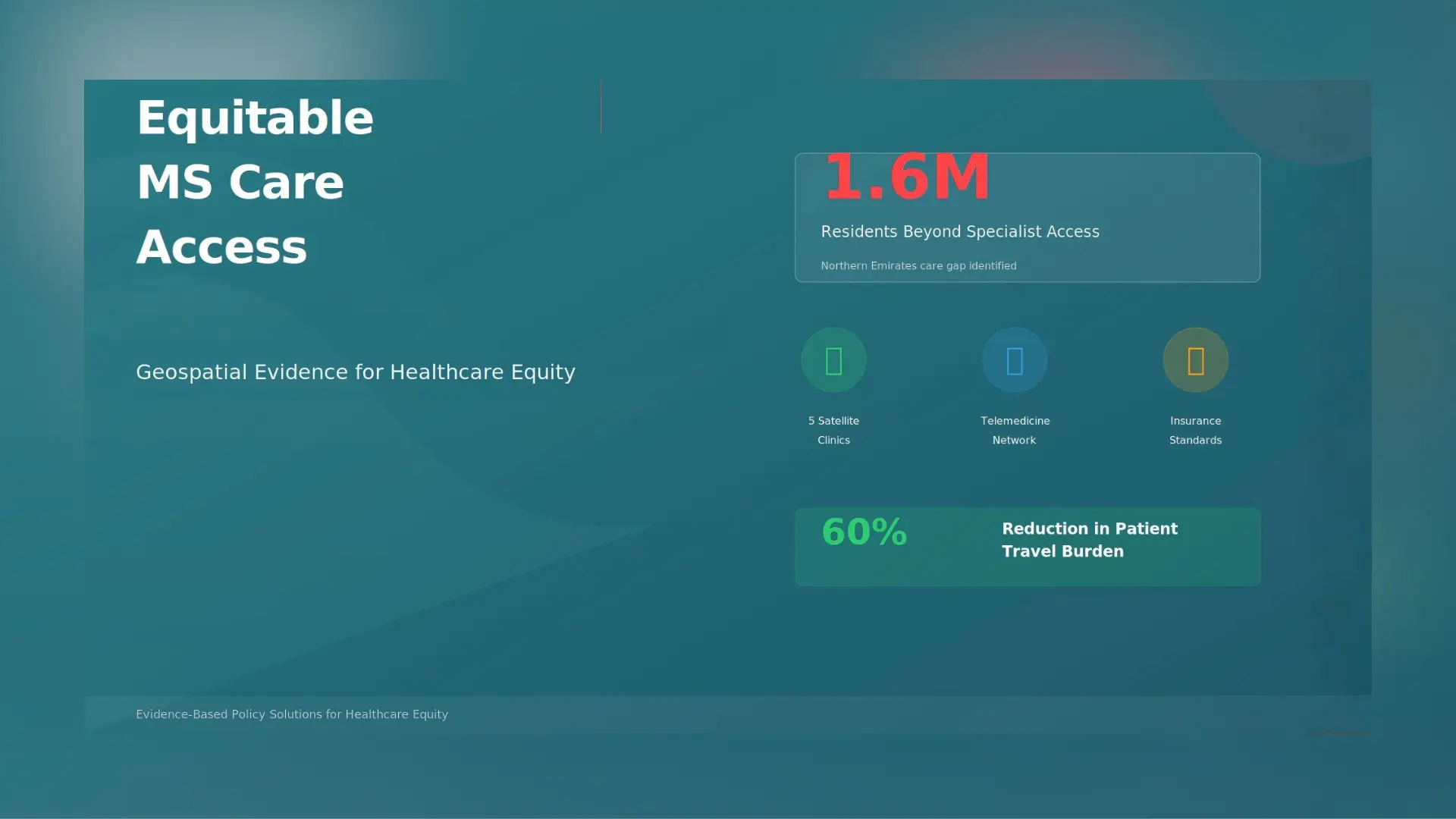
Research phase (April 2025–April 2026) completed with NMSS grant. Findings transitioning to policy council recommendations for pilot satellite clinic implementation in Northern Emirates, telemedicine infrastructure development, and insurance coverage standardization.

Target Population

Primary Target

Multiple Sclerosis patients in the UAE (estimated 2,500-3,000 individuals)

Secondary Populations

54.7% non-Emirati, requiring culturally-sensitive, multilingual care access

Geographic Focus

Northern Emirates residents (Ajman, RAK, Fujairah, UAQ) facing 90+ minute travel times

Policy Stakeholders

Healthcare authorities, insurance providers, patient advocates, neurologists

Impact & Outcomes

Apr 2025 – Nov 2026 (NMSS UAE Research Grant)
70%
Healthcare infrastructure concentration in 2 emirates only
1.6M
UAE residents beyond 90-minute access to specialized MS car
86
Patient encounter records from the 2020 claims dataset
14
Distinct insurance payers identified; complex coverage vari
60%
Projected travel time reduction via satellite clinic model
45%
Estimated improvement in treatment adherence with telemedic
70%
Healthcare infrastructure concentration in 2 emirates only
1.6M
UAE residents beyond 90-minute access to specialized MS car
86
Patient encounter records from the 2020 claims dataset
14
Distinct insurance payers identified; complex coverage vari
60%
Projected travel time reduction via satellite clinic model
45%
Estimated improvement in treatment adherence with telemedic

Interconnected Magazine

Now accepting submissions of interest for the upcoming issue.

Interconnected is the world’s only digital mental health magazine.

Want to be featured?

Email [email protected]

Initiative Overview

The Current Gap

Multiple Sclerosis affects 2,500–3,000 individuals in the UAE, with prevalence among the highest in the Gulf Cooperation Council region. Yet access to disease-modifying therapies remains deeply unequal. While Dubai and Abu Dhabi host world-class neurological care (8+ dedicated MS centers), the Northern Emirates have none.

Patients face 2–3 hour travel times for routine follow-up—a structural barrier affecting 1.6 million residents.

Our Solution

This initiative applies advanced geospatial analysis and health services research to quantify MS care access disparities and inform evidence-based policy solutions. Using GIS-based drive-time modeling, spatial clustering analysis, and location-allocation optimization, we identified five priority sites for satellite MS clinics with rotating specialist coverage from hub centers.

Our research synthesizes claims data, epidemiology, and stakeholder engagement (150+ participants) to produce eight implementation-ready recommendations including telemedicine infrastructure, insurance standardization, and dynamic GIS-based healthcare access indexing.

Key Features

1

Geospatial Evidence Base

Drive-time analysis, spatial clustering assessment, and heat mapping identify care deserts and optimize intervention sites using population-density-weighted modeling

2

Insurance Transparency Framework

Systematic audit of 14 payers reveals formulary gaps, prior authorization barriers, and nationality-based exclusions enabling standardization pathways

3

Hub-and-Spoke Delivery Model

Satellite clinics in 5 priority locations (RAK, Fujairah, Ajman/UAQ, Al Ain, Khor Fakkan) supported by telemedicine and rotating specialist coverage

4

Patient-Centered Economics

Quantifies indirect costs (transportation, lost wages, accommodation) demonstrating cost-effectiveness of satellite vs. centralized care models

5

Policy-Ready Recommendations

Eight implementation-ready recommendations sequenced by priority and lead-time, grounded in published epidemiology and international MS guidelines

6

Replicable Methodology

Framework directly applicable to mental health, chronic disease access, and regional health equity initiatives across Eastern Mediterranean Region

Collaboration in Action

Main Collaborators

  • 3
Dubai Health Authority

Join Our Global Community

Three ways to get involved:

Choose the level that fits.

Key Learnings

Data Protection Compliance: Balancing privacy (UAE Federal Decree-Law No.45/2021) with GIS-level granularity required for facility-specific analysis. Resolved through emirate-level aggregation and small-number suppression protocols.

Insurance System Complexity: 14 distinct payers with divergent formulary policies and prior authorization procedures. Stakeholder engagement required to identify harmonization pathways without disrupting existing patient relationships.

Cross-Emirate Governance: Healthcare authority fragmentation (DHA, MOHAP, Abu Dhabi DoH, individual emirate authorities) created coordination challenges. Addressed through multi-stakeholder policy council model with formal proceedings documentation.
1. Methodological Transferability: Research frameworks developed for neurological conditions illuminate mental health accessibility barriers, including urban concentration, insurance complexity, and stigma-related underutilization patterns.

2. Policy Council Engagement: Multi-stakeholder dialogues generated buy-in and implementation-ready recommendations, with participants becoming advocates for satellite clinic pilots and insurance standardization.

3. Data Governance as Enabler: Privacy-preserving geospatial outputs enabled rigorous analysis while maintaining compliance. Clarity on governance frameworks accelerated stakeholder participation.

4. Indirect Cost Documentation: Quantifying patient-borne costs shifted policy focus to access equity. Economic case for satellite clinics proved decisive in funding discussions.
Regional Health Equity Initiative: Extend geospatial framework to mental health, diabetes, and cardiovascular disease access planning across UAE and GCC.

eMHIC Mental Health Bridge: Leverage MS methodology to develop mental health accessibility index for EMR countries, revealing parallel barriers and enabling integrated policy solutions.

Education & Training: Host geospatial health equity workshops for healthcare policymakers, GIS practitioners, and implementation researchers across Gulf region.

Research Partnership: Joint publications on methodology, policy translation, and implementation science of evidence-based care access in multicultural, federated health systems.

Looking Ahead

Immediate (6–12 months): Pilot satellite MS clinic in one Northern Emirates site with rotating Rashid Hospital/Cleveland Clinic coverage; establish telemedicine infrastructure across all emirates with secure video consultation platforms; convene insurance standardization working group to harmonize DMT formularies.

Medium-term (1–2 years): Scale satellite clinic model to 3–4 additional sites based on pilot learnings; launch UAE MS Registry aligned with NMSS UAE/DoH Abu Dhabi/G42 partnership initiative; publish peer-reviewed articles on geospatial methodology and outcomes.

Long-term (2–5 years): Achieve 95%+ population coverage within 90 minutes of MS specialist care; establish regional evidence base for mental health and chronic disease access applications; position UAE as EMR leader in healthcare equity policy.
󠁯•󠁏󠁏 Establish regional evidence base for mental health, chronic disease access applications
󠁯•󠁏󠁏 Position UAE as EMR leader in evidence-based healthcare equity policy
eMHIC Directory_Key Contacts (4)

Key Contact

Prof. Immanuel Azaad Moonesar, R.D.
Principal Investigator & Professor
Mohammed Bin Rashid School of Government

Email

Website

PROMOTION

Directory Banner Placements (9)