Share this initiative
The Think Tank was delivered in November of 2025. The White Paper is being actively endorsed across countries.
Populations stewarding and making decisions to design, deliver, fund and enable mental health services
Now accepting submissions of interest for the upcoming issue.
Interconnected is the world’s only digital mental health magazine.
Want to be featured?
Email [email protected]
People across the world are increasingly using digital tools and AI as their entry point to find and access mental health support.
The digital environment is now a central part of how people seek help, make decisions and access care. AI represents the newest addition to this suite of innovation and change. AI describes technologies that can process and learn from external data, and adjust their behaviour to perform specific tasks. , AI tools can now be accessed by all help seekers with an internet connection, and are now where many mental health journeys begin. This expanding digital environment spans a range of tools and approaches that differ in how they function and how they are used in mental healthcare.
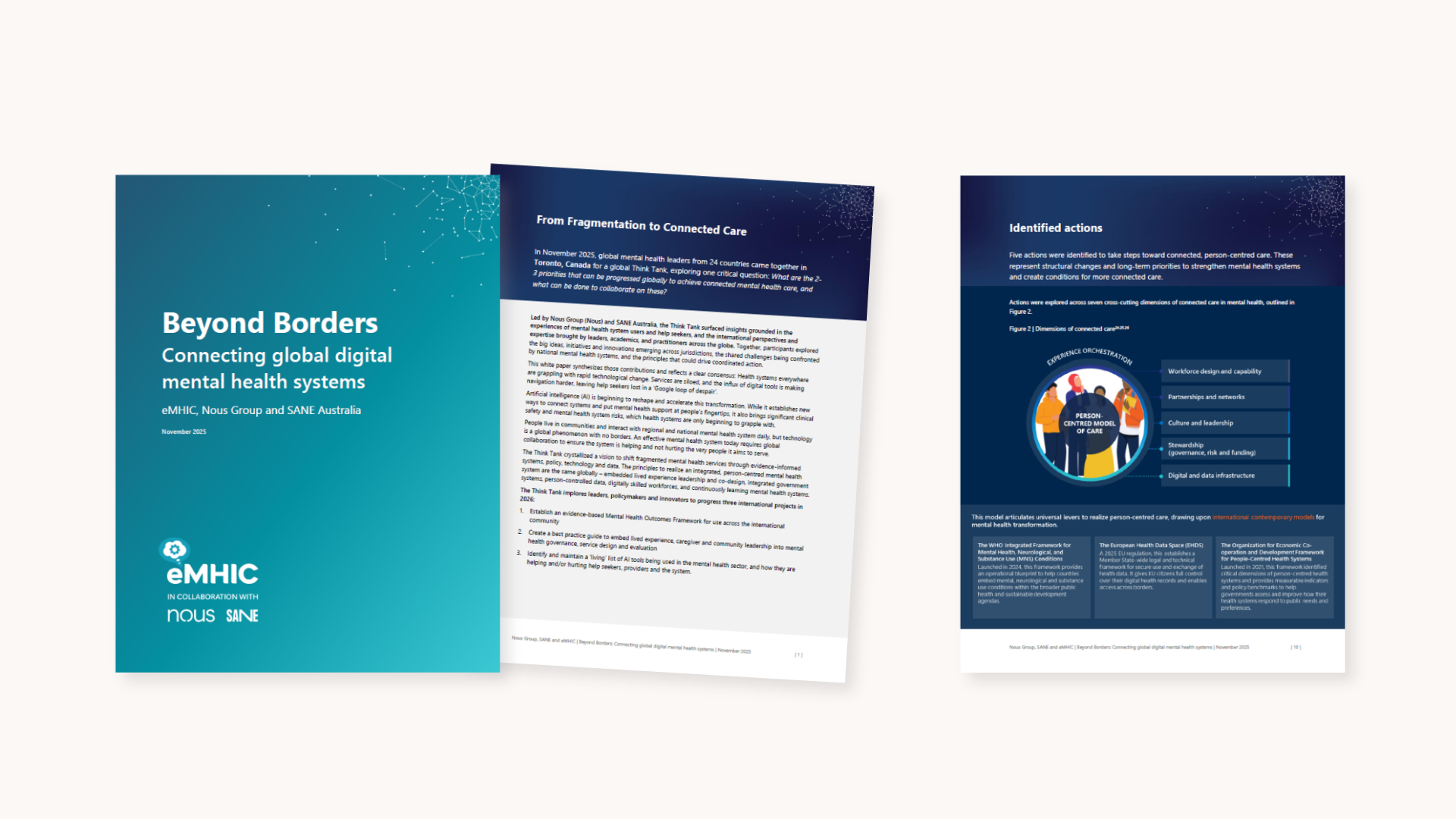
The Think Tank and White Paper are not the end for this work. The White Paper outlines a practical path for action, but represents a bigger call for leaders, policymakers and innovators across the globe to progress enhancements to the digital mental health landscape. Organizations interested in advancing the effectiveness of the system, and wellbeing of mental health system users and help seekers, are encouraged to connect and collaborate through the eMHIC network.
The Think Tank highlighted immediate steps that can be taken now to build shared understanding and drive progress towards more connected care. These steps crystallize a shared vision to shift fragmented mental health services through evidence-informed systems, policy, technology and data.
Three international projects were called upon to be progressed in 2026:
1. Establish an evidence-based Mental Health Outcomes Framework for use across the international community.
2. Create a best practice guide to embed lived experience, caregiver and community leadership into governance, service design and evaluation to achieve universal outcomes.
3. Identify and maintain a ‘living’ list of AI tools being used in the mental health sector.
An evidence-based Mental Health Outcomes Framework establishing shared outcomes and measures to enable international benchmarking, learning and system improvement.
A best practice guide embedding lived experience, caregiver and community leadership into governance, service design and evaluation.
A repository of mental health AI tools, documenting lessons learned and their impacts on help seekers, providers and systems.


Three ways to get involved:
Choose the level that fits.